
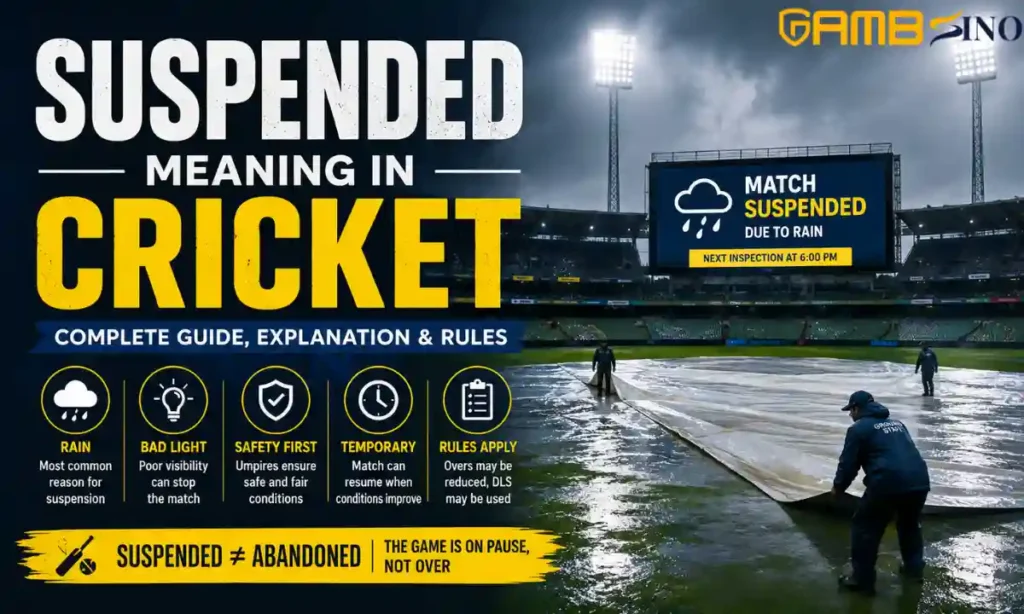
Cricket has many terms that can sometimes confuse new viewers as well as regular fans. One such term is “suspended,” which is commonly seen on live scorecards when a match suddenly stops. When viewers see “Match Suspended,” they may think that the game has been cancelled or permanently called off. However, in most cricket situations, suspended means that play has been temporarily stopped and may continue later when the conditions become suitable.
The term “suspended” can be used in different situations in cricket. It can describe a match that has been stopped because of rain, bad light or unsafe conditions, but it can also describe a player or team that has been temporarily prohibited from participating. Therefore, understanding the context is important. In this article, we will explain the suspended meaning in cricket, why matches are suspended, what happens after suspension, how rain affects the game, and how suspension differs from abandonment and postponement.
What Does Suspended Mean in Cricket?
In cricket, suspended means that play has been temporarily stopped because the conditions are not suitable for the match to continue at that particular time. The reason could be rain, bad light, a wet outfield, an unsafe pitch, lightning, security problems, technical issues or another unexpected situation. A suspended match is not necessarily finished because the officials can allow play to continue when conditions become safe and reasonable.
The easiest way to understand suspended is to think of it as a pause in the match. For example, if a team is batting at 120/4 when heavy rain starts, the umpires may suspend play and send the players off the field. The existing score remains part of the match, and if the conditions improve, the players can return and continue the game according to the applicable playing conditions.
Suspended Meaning in Cricket in Simple Words
In very simple language, suspended means temporarily stopped. It tells viewers that the match cannot continue at that moment, but there is still a possibility that it will restart. The scoreboard may display a message such as “Match Suspended Due to Rain” or “Play Suspended Due to Bad Light.” The players normally leave the field while officials and ground staff deal with the situation.
For example, imagine that a T20 team is chasing 175 and has scored 65/2 after eight overs when rain begins. If the scoreboard says “Match Suspended,” the team has not lost those 65 runs or two wickets. If play resumes, the innings will continue from the existing situation, although the number of overs available could change if a significant amount of playing time has been lost.
Why Is a Cricket Match Suspended?
A cricket match can be suspended for several different reasons, but the main purpose is to protect players and ensure that the game remains fair. Cricket involves fast bowling, running, jumping, diving and quick movements, so even a small change in ground or weather conditions can create a safety problem. The officials therefore have to consider whether continuing the match is reasonable.
Rain and bad light are the most familiar causes, but they are not the only possibilities. An unsafe pitch, slippery outfield, lightning, floodlight failure, security problem or another unexpected event can also result in play being suspended. The exact procedure can vary depending on the format, tournament and applicable playing conditions.
Rain
Rain is one of the most common reasons for a cricket match to be suspended. When rain becomes heavy enough to affect the playing surface, the umpires may stop the game and send the players off the field. Ground staff usually cover the pitch and other important areas to protect them from additional water.
Stopping the game because of rain is not simply about keeping the players dry. A wet pitch or outfield can become dangerous, particularly for bowlers and fielders who need to run quickly. Once the rain stops, the ground may still require considerable preparation before play can safely resume.
Bad Light
Bad light is another common reason for suspending cricket, especially in Test matches and other games where natural daylight changes during the day. If the light becomes too poor, batters may have difficulty seeing the ball clearly, while fielders can also struggle to judge fast-moving deliveries.
The umpires assess the available light and decide whether it is suitable for continued play. In some competitions, artificial lights can be used to improve visibility, but the officials still have to determine whether the overall conditions are safe and appropriate. If visibility remains poor, the suspension can continue until the situation improves.
Wet Pitch and Outfield
A wet pitch or outfield can also lead to a match suspension. Moisture on the playing surface can make it difficult for bowlers to maintain their footing and can make running or fielding dangerous. Batters may also face difficulties while running between the wickets if the surface becomes slippery.
However, the presence of some moisture does not automatically mean that a match must be suspended. The important issue is whether the conditions have become dangerous or unreasonable for normal cricket. Umpires examine the pitch, bowler’s run-up and outfield before deciding whether play can continue.
Lightning and Thunderstorms
Lightning can create a serious safety concern because cricket is played in an open outdoor environment. If a thunderstorm develops near the stadium, officials may suspend play and move players and other personnel away from the field. The match will generally remain stopped until the safety risk has passed.
Even when the rain becomes lighter, officials may continue to monitor the weather before allowing play to resume. The decision is based on the overall safety situation rather than simply whether rain is currently falling. Player and official safety takes priority over completing the match quickly.
Floodlight Failure
Modern cricket matches, particularly T20 and day-night games, often depend on floodlights. If the stadium’s lighting system fails or the available lighting becomes insufficient, play may have to be suspended. Poor lighting can make it difficult for players to see the ball and can create a safety issue.
Ground and stadium officials may work to fix the problem while the umpires monitor the situation. If adequate lighting is restored and the playing conditions are otherwise suitable, the match can continue. If the problem cannot be resolved, the competition rules determine what happens next.
Security Problems
Security concerns can also result in a cricket match being suspended. A pitch invasion, crowd disturbance, serious security threat or another incident can make it unsafe for players and officials to remain on the field. In such situations, the priority is to remove the immediate danger before considering a restart.
Depending on the nature of the incident, players may leave the field and wait in a secure area. Security personnel and match officials then work to resolve the problem. Once the situation has been brought under control, the responsible officials can determine whether the match is safe to resume.
Technical Problems
Sometimes a match may be suspended because of an unexpected technical issue. Problems with floodlights, ground equipment or other essential stadium facilities can prevent normal play from continuing. The length of the suspension depends on how quickly the problem can be resolved.
Technical interruptions are generally treated differently from weather interruptions because the cause is not related to the playing surface or environment. Nevertheless, the basic idea remains the same: play is temporarily stopped until the situation is suitable for the match to continue.
Who Decides When a Cricket Match Is Suspended?
The umpires have the main responsibility for deciding whether playing conditions are suitable. They examine the ground, weather, light and other circumstances and determine whether continuing the match would be unsafe or unreasonable. Their decision is based on the conditions at the venue rather than simply on what players or spectators would prefer.
In major international and professional competitions, other match officials may also be involved depending on the circumstances and tournament regulations. However, the on-field decision about whether conditions are suitable for cricket remains a key responsibility of the umpires. They also continue to monitor the situation after play has been suspended.
What Happens When a Cricket Match Is Suspended?
When a match is suspended, the first step is to stop play and make sure the players are safe. The players normally leave the field, while ground staff begin preparing the playing area. If rain is the cause, the pitch is usually covered, and staff may work on removing water from the outfield.
After that, officials monitor the situation and may conduct one or more inspections. They examine the pitch, outfield, bowler’s run-up, visibility and general playing conditions. If the officials decide that the conditions are suitable, they announce a restart time and the players return to the field.
Does the Score Count After a Match Is Suspended?
Yes, a normal suspension does not erase the score already recorded in the match. Runs scored, wickets taken and overs completed before the interruption remain part of the match. If the game resumes, the teams generally continue from the situation that existed when play was stopped.
For example, if a team is 98/3 after 14.2 overs when rain interrupts the game, those 98 runs and three wickets remain part of the match. The important thing that can change is the amount of playing time remaining. In a limited-overs match, a long interruption may reduce the number of overs available to the teams.
Does a Suspended Match Continue From Where It Stopped?
In most normal interruptions, the match continues from the point where it was stopped, subject to the applicable rules. The batters who were at the crease remain involved, and the wickets already lost continue to count. The innings does not simply restart from the beginning because of a temporary interruption.
However, a shortened match can look different from the original schedule. If enough playing time has been lost, the number of overs may be reduced. In a limited-overs chase, the target may also be adjusted according to the relevant rules, so the match can continue while having a different number of overs available.
Suspended vs Delayed in Cricket
The terms suspended and delayed are closely related, but they are often used in different situations. A delay usually means that the scheduled start or continuation of a match has been held back. A suspension more specifically indicates that play has been stopped or prevented from continuing because of unsuitable conditions or another interruption.
For example, if rain begins before a match starts and the toss or first ball is held back, the match may be described as delayed. If the teams have already started playing and rain forces them to leave the field, the situation is commonly described as play being suspended. The precise terminology can depend on the competition and broadcast.
| Term | Meaning |
|---|---|
| Suspended | Play has temporarily stopped |
| Delayed | Start or continuation has been held back |
| Abandoned | The match has been formally ended without completing the contest |
| Postponed | The match has been moved to another date or time |
| Resumed | Play has started again after an interruption |
Suspended vs Abandoned Match
A suspended match and an abandoned match are not the same thing. Suspension means the match has temporarily stopped and may still continue. Abandonment means the match has been formally ended because it cannot continue or because the applicable regulations no longer allow enough time for the intended contest.
For example, rain can first cause a match to be suspended. If the weather clears and enough time remains, the match may resume. If the weather continues throughout the available playing period and the requirements for completing the match cannot be met, officials may eventually abandon the game or apply another result specified by the competition regulations.
Suspended vs Postponed Match
A postponed match is generally a fixture that has been moved to another date or time. A suspended match, on the other hand, usually refers to a game that has been temporarily stopped and is still potentially capable of continuing under the existing schedule or applicable arrangements.
This distinction is especially useful when following tournament updates. If a match stops for two hours because of rain and later resumes on the same day, it is a suspended match. If the game is moved to another day because it cannot be played or completed as scheduled, it becomes a postponement or rescheduling situation.
What Does “Match Suspended Due to Rain” Mean?
When you see “Match Suspended Due to Rain” on a cricket scoreboard, it means that the umpires have temporarily stopped play because the rain or its effects have made the conditions unsuitable. Players usually leave the field while ground staff protect the pitch and prepare the playing area for a possible restart.
This message does not mean that the match has automatically been cancelled. The officials will monitor the weather, inspect the ground and determine whether the game can continue. If enough playing time is lost, the match may eventually have fewer overs, a revised target or another outcome depending on the applicable rules.
What Happens to Players During a Suspension?
During a normal rain or bad-light suspension, players generally leave the playing area and wait for the officials to decide whether conditions will improve. They may return to the dressing room while ground staff work on the field. Players are expected to remain ready because they may be called back once the umpires decide that play can restart.
If the reason for the suspension is a security issue, the players may be moved to a secure area instead. The exact procedure depends on the nature of the problem. Regardless of the reason, players cannot simply decide among themselves when to restart the match because the official decision must come from the responsible match officials.
What Is a Ground Inspection in Cricket?
A ground inspection is an assessment carried out by officials to determine whether the playing area is suitable for cricket. It normally takes place after an interruption when the conditions appear to have improved. An inspection does not automatically guarantee that the match will restart because officials may still find unsafe or unsuitable areas.
During an inspection, officials can examine the pitch, outfield, bowler’s run-up, visibility and general condition of the ground. They may also discuss the situation with ground staff and other relevant officials. After the inspection, they can announce a restart time, schedule another inspection or continue the suspension.
What Does “Inspection at 6 PM” Mean?
If the broadcast says “Umpires will inspect at 6 PM,” it means that the officials plan to examine the playing conditions around that time. It does not necessarily mean that the match will restart exactly at 6 PM. The inspection is simply a scheduled opportunity to determine whether play can safely continue.
After inspecting the ground, the umpires may announce that play will resume at a particular time. They may also decide that another inspection is needed if conditions remain uncertain. If the ground is still unsafe or there is not enough time to complete the required match, another decision may have to be made.
What Does “Play to Resume” Mean?
The phrase “play to resume” means that officials have planned a time for the players to return to the field after the suspension. Before that happens, the umpires need to be satisfied that the playing conditions are suitable. Ground staff may also need to complete preparation work before the players can take their positions.
A planned restart time can sometimes change because weather and ground conditions can change unexpectedly. Another shower or a problem with the playing surface may result in another delay. Therefore, the announced time should be understood as the planned restart rather than an absolute guarantee.
Suspended Meaning in Test Cricket
Suspensions are common in Test cricket because Test matches are played over several days. Rain or bad light can stop a day’s play without necessarily bringing the match to an end. If conditions improve, the teams can continue later on the same day or return for the next scheduled day’s play.
The longer format gives Test cricket more flexibility when dealing with interruptions. Losing several hours to rain can reduce the amount of cricket played on a particular day, but the match can still continue over the remaining days. This is why a Test match can be suspended multiple times without necessarily being abandoned.
Suspended Meaning in ODI Cricket
In One Day International cricket, a suspension can have a major impact because the match has a fixed number of overs and a limited amount of playing time. A long interruption may make it impossible to complete the original 50-over contest.
When play resumes after a substantial interruption, the number of overs may be reduced according to the applicable competition regulations. If the interruption affects the team batting second, the target may also need to be revised. This can completely change the strategy of the remaining innings.
Suspended Meaning in T20 Cricket
Suspension can have an even greater effect on T20 cricket because the format has a short playing window. A lengthy rain interruption can quickly make it impossible to complete the original 20 overs per side. Officials may therefore need to reduce the number of overs available to one or both teams.
A shortened T20 match can become much more aggressive because the batting side has fewer deliveries available. Teams may have to attack from the beginning instead of building an innings slowly. A revised target may also change the calculations for the chasing team, making the final stages of a rain-affected T20 match particularly unpredictable.
Does DLS Apply When a Match Is Suspended?
No, not automatically. The appearance of the word “suspended” does not mean that the Duckworth-Lewis-Stern method has immediately been applied. DLS becomes relevant when an interruption in a limited-overs match reduces the playing opportunity and the applicable regulations require a revised target.
If the rain interruption is short and the original match structure can continue, there may be no need for DLS. However, if enough time is lost to reduce the number of overs available, the relevant regulations can require a revised target for the chasing team.
What Is the Duckworth-Lewis-Stern Method?
The Duckworth-Lewis-Stern method, commonly called DLS, is used in limited-overs cricket to calculate a revised target when interruptions prevent both teams from receiving the same number of overs. The method considers the resources available to a batting team, including the combination of overs remaining and wickets in hand.
The purpose of DLS is to create a reasonable target after an interruption changes the amount of cricket that can be played. Instead of simply dividing the original target according to the number of overs lost, the system takes into account the different value of wickets and overs at different stages of an innings.
Example of a Suspended T20 Match
Imagine Team A scores 180/6 in 20 overs during the first innings. Team B starts its chase and reaches 60/1 after 7 overs when heavy rain arrives. The umpires suspend play because the outfield has become too wet for safe cricket.
If the rain stops quickly and enough time remains, Team B can continue its chase. If a long period is lost, the number of overs available may be reduced and a revised target can be calculated under the applicable rules. If conditions never become suitable again, the match may eventually be abandoned or receive another official outcome.
Can a Suspended Match Resume the Next Day?
Yes, a suspended match can sometimes continue on another day, but this depends on the format and competition regulations. Test matches already have multiple scheduled days, so a weather interruption can naturally carry into the next day’s play. Some limited-overs competitions may also provide reserve days for specific matches.
A reserve day does not apply automatically to every match. Tournament organisers establish the relevant rules before the competition begins, including what happens if weather prevents a match from being completed. Therefore, fans should check the specific tournament regulations when trying to understand what will happen after a major suspension.
What Happens If a Suspended Match Cannot Resume?
If the conditions never improve sufficiently for play to continue, the suspended match may eventually be abandoned or concluded according to the applicable competition rules. Officials consider the amount of cricket already played, the time remaining and whether the regulations allow an official result to be produced.
The final outcome can differ from one tournament to another. Depending on the circumstances, a match may be completed as a shortened contest, declared a no-result game or abandoned. A reserve day can also affect the decision in competitions where such an arrangement exists.
Does Suspension Change the Match Result?
A suspension by itself does not decide the result of a cricket match. It only indicates that play has temporarily stopped. The final result depends on what happens after the interruption and which rules apply to the competition.
A match can resume normally and produce a winner, continue as a shortened contest, or fail to produce a result. Therefore, when a scoreboard says “Suspended,” fans should not assume that either team has won or lost. The final outcome will only become clear after the officials determine how the match can proceed.
Does Suspension Affect Player Statistics?
A temporary suspension does not normally erase the statistics that have already been recorded. If a batter scores 75 runs before rain stops the match, those runs remain part of the match situation. Similarly, wickets taken and overs completed before the interruption remain relevant if the match continues.
However, the official treatment of a match can depend on its final status. A completed match, abandoned match, no-result match and other types of outcomes can have different statistical implications. This is why the final official result is important when considering how a match appears in player and team records.
What Does Player Suspended Mean in Cricket?
The phrase “player suspended” has a completely different meaning from “match suspended.” When a player is suspended, it generally means that the player has been temporarily prohibited from participating in cricket because of a disciplinary or regulatory matter.
A player may receive a suspension after a serious breach of the rules or code of conduct, depending on the circumstances. The length of the suspension can vary, and it may apply to a specific number of matches or a particular period. Therefore, readers should always look at the official reason and terms of the suspension.
What Does “Suspended for One Match” Mean?
When a cricketer is suspended for one match, it generally means that the player is not permitted to participate in the specified match as part of a disciplinary sanction. The suspension is usually limited to the match or period stated in the relevant decision.
It does not necessarily mean that the player has been banned from cricket permanently. Once the suspension has been served and any other conditions have been satisfied, the player may become eligible to return. The exact meaning depends on the rules and authority that imposed the sanction.
Can a Team Be Suspended in Cricket?
Yes, a team, club or cricket organisation can also be suspended in certain circumstances. A team suspension is generally an administrative or disciplinary action that restricts participation in a competition or cricket activity.
This is very different from a match suspension. A match suspension is usually connected to weather, ground conditions or another event affecting a particular game. A team suspension relates to the eligibility or conduct of the team or organisation itself.
Can a Tournament Be Suspended?
In unusual circumstances, an entire tournament can also be temporarily suspended. This can happen when circumstances affect the competition as a whole rather than a single match. Serious security concerns, major external disruptions or other exceptional events can potentially lead to such a decision.
A tournament suspension is therefore an administrative matter. It should not be confused with the normal use of “match suspended,” which viewers usually encounter when an individual game is interrupted.
Does a Wet Field Automatically Suspend a Match?
No, a wet field does not automatically mean that play must be suspended. The officials need to determine whether the wetness has made the conditions dangerous or unreasonable. If players can still perform normal cricketing actions safely, the match may continue.
However, if bowlers are slipping, fielders cannot move safely or batters cannot run between the wickets without unreasonable risk, the umpires may stop play. The decision depends on the actual condition of the playing surface rather than simply whether the ground is wet.
Why Do Umpires Take Time Before Restarting After Rain?
When the rain stops, the ground may still require significant preparation before cricket can restart. Water may remain on the outfield, certain areas may be slippery and the pitch can retain moisture. The ground staff therefore need time to make the surface playable.
The umpires also need to inspect the conditions rather than relying only on the appearance of the field. They consider the pitch, outfield, bowler’s run-up, visibility and overall safety. This explains why players sometimes wait for a long period even after the rain has stopped.
Can Umpires Refuse to Restart a Suspended Match?
Yes, umpires can decide that a match should remain suspended even when the original reason for the interruption appears to have improved. For example, rain may have stopped, but the outfield could still be too slippery for safe fielding. Similarly, poor light may continue even after other weather conditions improve.
The officials are responsible for ensuring that the conditions are suitable before play resumes. A clear sky does not automatically mean the ground is ready. The final decision depends on the condition of the playing area and the safety of everyone involved.
Can Captains Decide Whether a Match Resumes?
Captains can communicate with the umpires and provide their views, but they do not have the final authority to restart a suspended match. The decision about whether the conditions are suitable belongs to the responsible officials under the applicable laws and playing conditions.
This prevents one team from being pressured into playing when it believes the conditions are unsafe. It also prevents the other team from unnecessarily delaying play when conditions are actually suitable. The officials therefore make the final decision based on safety and fairness.
Suspended Meaning in IPL Cricket
In IPL matches, the term “Match Suspended” is most commonly associated with temporary interruptions such as rain or unsuitable playing conditions. Since IPL games are T20 matches, weather interruptions can have a particularly strong effect on the number of overs that can be completed.
If play resumes after a long interruption, the match may become a shortened contest depending on the available time and applicable rules. This can lead to revised overs and potentially a revised target. If conditions prevent enough cricket from being played, the match may eventually receive a no-result or other official outcome.
Why Suspension Can Change T20 Match Strategy
A suspension can completely change the tactical situation in a T20 match. A team preparing for a 20-over innings may suddenly find itself with only a small number of overs remaining after a long interruption. Batters may therefore need to attack much earlier, while bowlers may have fewer opportunities to use different combinations.
The chasing team’s calculations can also change when the available overs are reduced. A target that originally required a steady scoring rate may become a much more aggressive chase after the number of overs is cut. This is one reason rain-affected T20 matches can produce dramatic changes in momentum.
How to Read a Cricket Scorecard During a Suspension
When a match is suspended, fans should look at the complete information shown on the scoreboard instead of focusing only on the word “suspended.” The current score, wickets, overs completed and reason for the interruption help explain exactly where the match stands.
It is also useful to watch for inspection times, expected restart times, revised overs and revised targets. These details are normally announced only after officials have assessed the situation. Until an official update is given, viewers should avoid assuming that the match will definitely be shortened or abandoned.
Common Misconceptions About Suspended Matches
Myth 1: Suspended Means Cancelled
This is incorrect. Suspended usually means temporarily stopped, and the match can still resume if conditions become suitable and enough time remains.
Myth 2: The Score Starts From Zero
This is also incorrect. A normal suspension does not erase the runs, wickets or overs already recorded. If play resumes, the match generally continues from the existing situation.
Myth 3: DLS Starts Immediately
DLS does not automatically apply the moment rain interrupts a match. It becomes relevant only when the applicable limited-overs rules require a revised target because the interruption has changed the available playing resources.
Myth 4: Every Suspended Match Becomes a No Result
Not every suspended match ends without a result. Many matches resume after an interruption and are completed normally or as shortened contests.
Myth 5: Only Rain Causes Suspension
Rain is one of the most common causes, but bad light, dangerous ground conditions, lightning, security concerns, technical problems and other unexpected situations can also stop play.
Important Terms Related to Suspended Matches
| Cricket Term | Simple Meaning |
|---|---|
| Match Suspended | The match has temporarily stopped |
| Rain Suspension | Play has stopped because of rain or its effects |
| Bad Light | Visibility is unsuitable for safe play |
| Inspection | Officials examine the playing conditions |
| Resume | Play starts again after an interruption |
| Abandoned | The match is formally ended without being completed |
| No Result | The match does not produce a winner under the applicable rules |
| Reduced Overs | Fewer overs are available than originally scheduled |
| DLS | A method used to revise targets in interrupted limited-overs matches |
| Reserve Day | An additional day available under certain tournament rules |
| Player Suspension | A disciplinary restriction preventing a player from participating |
Real Example of How a Suspension Works
Suppose Team A scores 170/7 in 20 overs and Team B starts its chase. Team B reaches 55/1 after six overs when heavy rain arrives. The umpires decide that the field has become too wet and suspend the match.
The players leave the field while ground staff cover the pitch and prepare the outfield. If the weather improves, the umpires inspect the ground and may allow the chase to continue. If considerable time has been lost, the remaining number of overs can be reduced and the target may be adjusted according to the applicable rules.
What Happens When a Suspended Match Is Finally Abandoned?
If conditions do not improve sufficiently, officials may eventually declare that the match cannot continue. The final treatment depends on the tournament’s regulations and factors such as the amount of cricket already completed, the time remaining and whether the requirements for an official result have been satisfied.
In some cases, the game may be recorded as a no-result match. In other circumstances, a reserve day or another competition-specific provision may apply. Therefore, a suspended match should never be considered abandoned until the officials make the relevant final announcement.
FAQs
What does suspended mean in cricket?
Suspended means that play has been temporarily stopped because the conditions or circumstances are unsuitable for continuing the match at that moment. The game may resume when conditions become safe and reasonable.
Does suspended mean the cricket match is over?
No. A suspended match is not automatically over. It can resume if the conditions improve and the relevant playing conditions allow sufficient time for cricket to continue.
What is the most common reason for a cricket match being suspended?
Rain is one of the most common reasons, but bad light, wet ground conditions, lightning, security issues and technical problems can also result in a suspension.
Who decides whether a match should be suspended?
The umpires have the main responsibility for deciding whether conditions are suitable for play. They assess the ground, weather, light and other circumstances before stopping or restarting the match.
Does the score count after a suspension?
Yes. A normal suspension does not erase the runs, wickets or overs already recorded. If play resumes, the match generally continues from the existing position.
What is the difference between suspended and abandoned?
Suspended means that play has temporarily stopped, while abandoned means that the match has been formally ended without completing the intended contest. A suspended match can eventually become abandoned if play cannot resume.
What is the difference between suspended and postponed?
Suspended normally describes a temporary stoppage of an existing match, while postponed generally means that a fixture has been moved to another date or time.
Conclusion
The suspended meaning in cricket is straightforward once it is understood in the right context. When a scoreboard displays “Match Suspended,” it normally means that play has been temporarily stopped because of rain, bad light, unsafe ground conditions, lightning, security concerns, technical problems or another interruption. It does not automatically mean that the match has been cancelled or that one team has won.
During a suspension, the existing match situation generally remains intact. The players leave the field, ground staff prepare the playing area and the umpires monitor the conditions. Once the officials believe that the ground and weather are suitable, play can resume. In limited-overs cricket, a lengthy interruption may reduce the number of available overs and can result in a revised target under the relevant rules.
The most important difference to remember is between suspended and abandoned. Suspended means temporarily stopped, while abandoned means the match has been formally ended without being completed. Similarly, match suspended and player suspended have completely different meanings. So, whenever you see “Match Suspended” during a live cricket game, the simplest interpretation is: the game is on pause and may continue once the situation is suitable for play.
Also, Read About: