
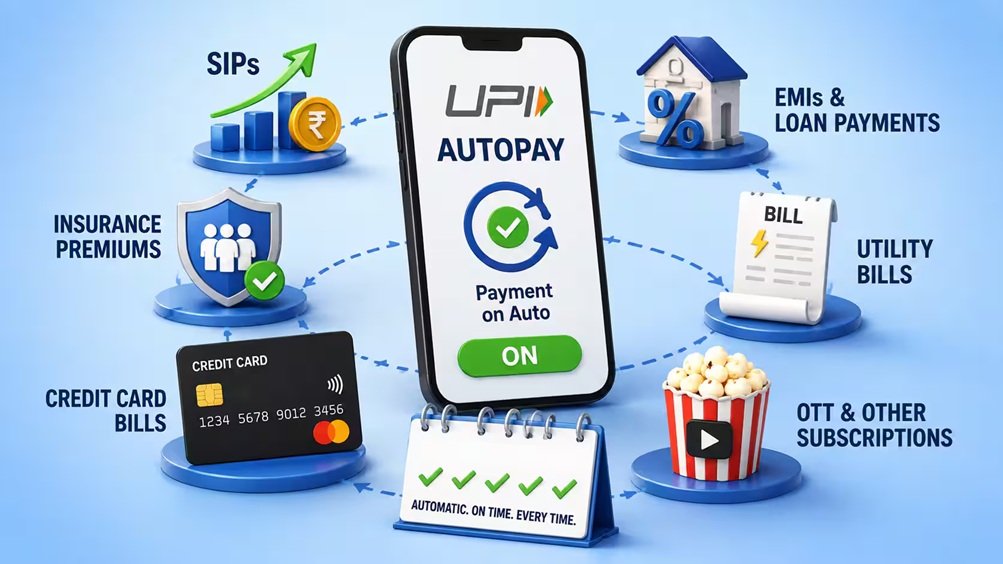
The introduction of UPI Autopay has made managing regular payments become more easy and quicker. By allowing users to set payments for eligible bills, subscriptions, and other services, they can be processed automatically as per the approved terms and dates. But there are many users who always wonder whether this feature affects their credit score or not.
Using a UPI app helps make recurring payments convenient through a single dashboard, but when you set up an Autopay, it does not directly increase or decrease your credit score; timely EMIs and credit card dues can effectively have an impact on your score.
What Is UPI Autopay?
A service by many UPI apps that allows users to set payments for their recurring payments is referred to as UPI Autopay. Rather than remembering the dates for multiple payments each time, it allows you to approve a mandate that has been set and allows eligible transactions to be processed automatically, so you don’t miss any payments.
However, it is always advised that users, before they approve any mandate, they must check the payment amount, frequency, validity, merchant or service details and other applicable terms and conditions. This can be useful for recurring expenses such as subscriptions, utility bills and other eligible services.
Does UPI Autopay Affect Your Credit Score?
So, as mentioned earlier, choosing UPI Autopay does not directly affect your credit score; UPI is a payment method and credit scores are based on how well you manage your finances and the information that has been reported by lenders and other financial institutions.
So, automatic payments of subscriptions or utility bills by UPI apps do not affect the score, but when the payment is made for a credit product like loans or credit cards, it impacts the score directly.
Can Autopay Help Avoid Missed Credit Payments?
When the loan EMIs and credit card dues are linked to UPI Autopays, the payment is processed as per the instructions, which also helps reduce the possibility of forgetting the scheduled payments.
Timely repayment of credit obligations matters because lenders can report repayment behaviour to credit bureaus. Therefore, using a UPI app for an eligible automatic repayment can support better payment management, provided sufficient funds are available and the mandate remains active.
Autopay should not, however, be treated as a guarantee that a payment will always succeed.
What Should You Check Before Setting Up Autopay?
Here are the important things that must be checked when you are setting up an Autopay service through the UPI app:
- Check the exact identity and other details of the merchant or the business that is requesting the deduction.
- Ensure you check the payment amount, whether it is fixed or can differ according to the bill.
- Know the frequency, or how often the amount will be processed and deducted from your account.
- Check the validity, the start and end dates of the mandate.
- The linked bank account needs to be checked to understand if the amount is deducted from the right account.
- Make sure you know the cancellation options or how you can pause the service when required.
- Your bank account must have sufficient bank balance when any of the important payment due date is around the corner.
Conclusion
UPI Autopay is primarily a convenient way to manage recurring payments and does not directly affect a person’s credit score merely because a mandate is created. However, when automatic payments are used for credit-related obligations, ensuring that payments are completed on time can help users manage their repayment responsibilities.
Bajaj Finserv’s Bajaj Pay UPI and UPI Lite provide convenient options for everyday digital transactions. Users can scan any QR code, pay contacts, transfer money to a bank account or UPI ID, check their balance and view payment history. The service can also be used for gas, electricity, credit card bills, loan repayments, DTH and FASTag payments, along with mobile recharges. This makes a UPI app useful for managing a range of everyday payment requirements.