
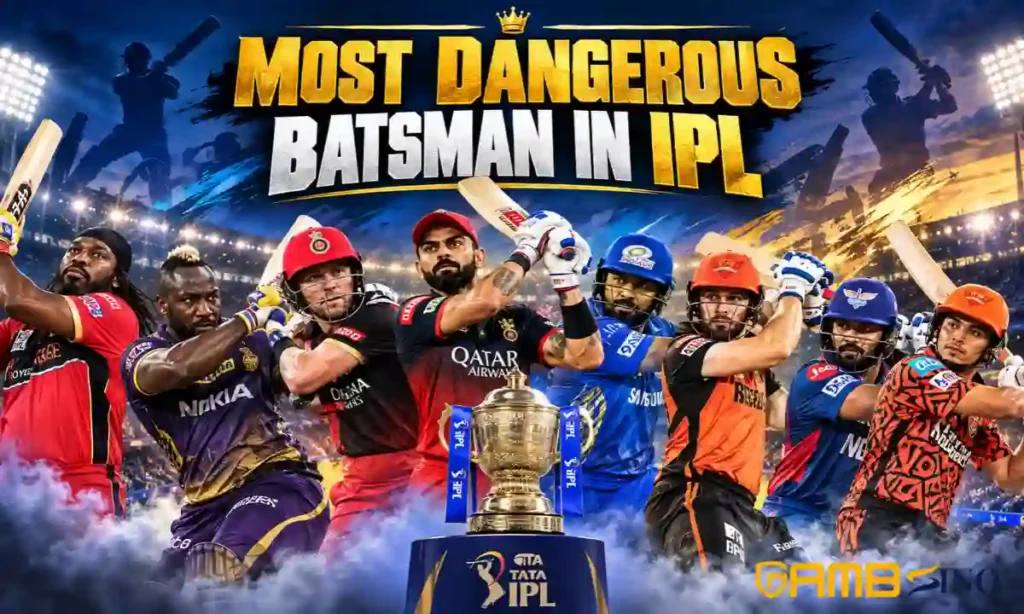
The Indian Premier League has produced some of the most destructive batsmen in the history of T20 cricket. Since the tournament began, several batters have entertained fans with powerful sixes, rapid scoring and match-changing innings. In T20 cricket, a batsman does not always need to spend a long time at the crease to influence the result. A few overs of extraordinary hitting can completely change the momentum of a match.
The phrase Most Dangerous Batsman in IPL can have different meanings depending on the qualities being considered. Some players are known for enormous sixes, some for extraordinary strike rates, while others combine consistency with the ability to accelerate quickly. Players such as Chris Gayle, AB de Villiers, Andre Russell, Virat Kohli, Rohit Sharma and several modern-day power hitters have all created their own identities in the IPL.
The league has also seen a new generation of highly aggressive batsmen who are willing to attack from the first delivery. Their fearless approach has made powerplay batting more aggressive and has pushed the expected scoring rate higher than ever before.
What Makes a Batsman Dangerous in IPL?
A dangerous IPL batsman is generally a player who can put immediate pressure on the bowling side. Such a batter can score boundaries regularly, rotate the strike quickly and increase the scoring rate whenever the team needs acceleration.
Strike rate is an important factor when evaluating an explosive batsman, but it is not the only measurement. The number of runs scored, sixes hit, hundreds, match-winning innings and performances against different bowling attacks are also important.
A truly dangerous batsman can adapt to different situations. He may attack during the powerplay, control the middle overs against spin and then produce an explosive finish during the final five overs.
Most Dangerous Batsman in IPL – Quick Overview
| Batsman | Major Strength | Notable IPL Achievement |
|---|---|---|
| Chris Gayle | Six-hitting and power | Highest individual IPL score of 175* |
| Andre Russell | Death-over hitting | Extremely high IPL strike rate |
| AB de Villiers | 360-degree stroke play | Famous for innovative batting |
| Virat Kohli | Consistency and acceleration | One of IPL’s leading run-scorers |
| Rohit Sharma | Timing and power | Among IPL’s leading six-hitters |
| Sunil Narine | Aggressive opening | Successful transition into power hitting |
| Heinrich Klaasen | Spin-hitting | Exceptional modern strike-rate numbers |
| Nicholas Pooran | Left-handed power | One of the most explosive modern batters |
| Abhishek Sharma | Powerplay aggression | Highly aggressive opening approach |
| Vaibhav Sooryavanshi | Extreme acceleration | Extraordinary recent IPL numbers |
Chris Gayle – The Original IPL Powerhouse
Chris Gayle is one of the first names that comes to mind when discussing dangerous batsmen in IPL history. His combination of size, strength, timing and extraordinary bat speed made him one of the most feared T20 batsmen in the world.
Gayle’s biggest strength was his ability to hit sixes without appearing to put excessive effort into every shot. Once he settled at the crease, even experienced bowlers found it difficult to control the scoring rate.
His most famous IPL performance came in 2013 when he scored an unbeaten 175 runs for Royal Challengers Bangalore. The innings remains one of the greatest individual performances in IPL history and demonstrated the extraordinary level of destruction Gayle could produce.
Gayle also became synonymous with six-hitting. His ability to clear long boundaries made him particularly dangerous on batting-friendly pitches. Bowlers often had to change their lengths and fields simply to reduce the risk of another six.
Chris Gayle IPL Power-Hitting Records
| Statistic | Record |
|---|---|
| Highest IPL Score | 175* |
| IPL Sixes | 313 |
| IPL Hundreds | 6? |
| Famous IPL Team | Royal Challengers Bangalore |
| Major Strength | Power hitting |
| Batting Style | Left-handed |
Gayle’s influence on IPL batting remains significant because he showed just how quickly one player could change the outcome of a T20 match.
Andre Russell – One of the Most Explosive Finishers
Andre Russell is another batsman who has built a reputation for extraordinary power hitting. Unlike many top-order batters, Russell often arrives at the crease with limited deliveries remaining, which makes his ability to score rapidly particularly valuable.
His powerful swing allows him to hit sixes from deliveries that many other batsmen would struggle to turn into boundaries. His attacking style is especially effective during the death overs.
Russell became closely associated with Kolkata Knight Riders and developed a reputation for producing remarkable innings under pressure. His ability to score a large number of runs from a relatively small number of deliveries has made him one of the most dangerous finishers in IPL history.
AB de Villiers – The 360-Degree Match Changer
AB de Villiers brought a completely different style of danger to IPL batting. His biggest strength was his ability to score boundaries into almost every area of the ground.
He could hit fast bowlers behind square, use his wrists against spin and play innovative shots over the wicketkeeper. Because he was capable of scoring on both sides of the field, bowlers found it difficult to predict where the next boundary would come from.
His partnership with Virat Kohli also produced some memorable IPL batting performances. Together, they formed one of the most famous batting combinations associated with Royal Challengers Bangalore.
De Villiers was not dependent on one particular shot. His versatility allowed him to change his approach according to the bowler, pitch and match situation.
Virat Kohli – Consistency Combined With Aggression
Virat Kohli represents another form of dangerous IPL batting. His game is built around excellent timing, strong running between the wickets, controlled aggression and the ability to bat for long periods.
Kohli has been one of the most consistent run-scorers in IPL history. His ability to construct an innings before increasing the scoring rate makes him particularly effective in T20 cricket.
Although Kohli is not always associated with the same kind of brute force as Gayle or Russell, his ability to score boundaries while maintaining a high level of consistency makes him a dangerous opponent.
His performances also demonstrate that dangerous batting does not necessarily mean attempting a six on every delivery. Building an innings and then accelerating at the right moment can be equally destructive.
Rohit Sharma – Power Hitting and Big Innings
Rohit Sharma has been one of the most recognizable Indian power hitters in the IPL. His natural timing allows him to generate tremendous distance without relying entirely on brute strength.
Rohit’s pull shot and lofted drives are particularly effective when he finds his rhythm. He can turn slightly short deliveries into boundaries and punish bowlers who miss their lengths.
He has also been an important player in high-pressure IPL matches. His combination of leadership experience, batting ability and big-match temperament has made him one of the tournament’s most influential players.
Sunil Narine – The Unusual Power Hitter
Sunil Narine originally became famous as a mystery spinner, but his transformation into an aggressive opening batsman added a completely new dimension to his IPL career.
When promoted to the top of the batting order, Narine adopted a highly attacking approach. Instead of spending several overs building an innings, he often looked to attack immediately.
His ability to strike boundaries during the powerplay made him a valuable attacking option for Kolkata Knight Riders. His story also demonstrates how T20 cricket can encourage players to develop skills outside their traditional roles.
Heinrich Klaasen – Modern Spin-Hitting Specialist
Heinrich Klaasen has become one of the most dangerous middle-order batsmen in modern T20 cricket. His ability to attack spin is particularly impressive.
Klaasen uses his strength, footwork and bat speed to target spinners. He can hit straight, over midwicket or behind square depending on the delivery.
His batting becomes particularly dangerous when he gets several overs at the crease. Once he understands the pitch and bowling conditions, he can increase the scoring rate dramatically.
Klaasen’s performances have also shown the growing importance of specialized spin-hitting in modern T20 cricket.
Nicholas Pooran – Explosive Left-Handed Batting
Nicholas Pooran has established himself as one of the most exciting left-handed power hitters in the IPL. His ability to attack both pace and spin makes him difficult to contain during the middle and death overs.
Pooran is capable of producing huge sixes with relatively little backlift. His quick hands allow him to punish short or full deliveries before bowlers have enough time to recover.
His aggressive batting style has made him an important middle-order player, particularly when a team needs a rapid increase in scoring.
Abhishek Sharma – One of the Most Aggressive Young Batters
Abhishek Sharma has emerged as one of the most aggressive young Indian batsmen in the IPL. His approach is particularly noticeable during the powerplay.
Instead of waiting for the bowling side to make mistakes, Abhishek frequently looks to attack deliveries in his scoring areas. His ability to hit both pace and spin allows him to maintain pressure during the early overs.
His fearless batting has contributed to the changing nature of powerplay cricket. Modern opening batsmen increasingly look to maximize the first six overs rather than simply protect their wickets.
Vaibhav Sooryavanshi – The New-Age Explosive Batsman
Vaibhav Sooryavanshi represents the next generation of aggressive IPL batting. His attacking approach and extraordinary scoring speed have attracted considerable attention.
His 2026 IPL season was particularly remarkable, with 776 runs at a strike rate of 237.30 and 72 sixes. These numbers illustrate just how aggressively modern T20 batsmen are approaching the game.
He has also produced one of the fastest centuries in IPL history. His ability to reach three figures in a very small number of deliveries demonstrates his attacking mentality.
Vaibhav Sooryavanshi IPL 2026 Statistics
| Statistic | IPL 2026 |
|---|---|
| Matches | 16 |
| Runs | 776 |
| Average | 48.50 |
| Strike Rate | 237.30 |
| Highest Score | 103 |
| Hundreds | 1 |
| Fifties | 5 |
| Fours | 63 |
| Sixes | 72 |
His numbers demonstrate a completely modern approach to T20 batting, where scoring speed can be just as important as the number of runs accumulated.
What Makes Vaibhav So Dangerous?
The most noticeable feature of Vaibhav’s batting is his ability to score extremely quickly. A strike rate above 200 is already considered highly aggressive, while a strike rate above 230 over a full season represents an extraordinary scoring rate.
His six-hitting is another major strength. When a young batter can consistently clear the boundary, captains are forced to rethink bowling lengths and field placements.
The pressure created by such a batsman is not limited to the number of runs he scores. His attacking approach can force bowlers to abandon their preferred plans and attempt more defensive options.
Most Dangerous Batsmen Based on Different Strengths
There is no single quality that defines dangerous IPL batting. Different players have dominated different areas of the game.
| Batting Quality | Notable Batsman |
|---|---|
| Massive power | Chris Gayle |
| Death-over hitting | Andre Russell |
| Innovative stroke play | AB de Villiers |
| Long-term run scoring | Virat Kohli |
| Timing and power | Rohit Sharma |
| Powerplay aggression | Abhishek Sharma |
| Spin destruction | Heinrich Klaasen |
| Left-handed power | Nicholas Pooran |
| Extreme strike rate | Vaibhav Sooryavanshi |
| Aggressive opening | Sunil Narine |
Highest Individual Score in IPL
The highest individual score is one of the clearest examples of destructive batting. Chris Gayle’s unbeaten 175 remains one of the most remarkable innings in IPL history.
That innings demonstrated how a single player can dominate an entire bowling attack. Gayle combined boundaries with an extraordinary number of sixes and maintained an incredible scoring rate throughout the innings.
Other legendary individual performances have also crossed the 150-run mark, showing that IPL batting has repeatedly produced extraordinary individual scores.
Fastest Centuries in IPL
Fast centuries provide another way to understand explosive batting. Reaching 100 runs in fewer than 40 deliveries requires an extraordinary combination of boundary hitting, timing and calculated risk.
Modern IPL cricket has produced several batsmen capable of reaching centuries at remarkable speed. Vaibhav Sooryavanshi’s rapid century became one of the most talked-about achievements of the recent IPL era.
Chris Gayle’s famous 30-ball century is another iconic example of extreme T20 acceleration.
Most Sixes in IPL History
Six-hitting is one of the most recognizable characteristics of a dangerous T20 batsman. Chris Gayle has long been associated with the record for most IPL sixes, while Rohit Sharma and Virat Kohli have also accumulated enormous six counts during their long IPL careers.
Sixes can change a match more quickly than almost any other batting event. A sequence of three or four sixes can add 20 or 25 runs within a handful of deliveries.
This is why power hitters are so valuable during the final overs of an IPL innings.
Most Dangerous Batsman in IPL History
Several batsmen have strong claims based on different definitions of danger. Chris Gayle’s combination of huge scores and extraordinary six-hitting represents traditional IPL power batting.
Andre Russell represents explosive finishing, especially when a team needs a large number of runs from a limited number of deliveries. AB de Villiers became famous for his unpredictable shot selection and ability to score all around the ground.
Virat Kohli and Rohit Sharma provide another model, combining consistency with the ability to produce attacking innings. The modern generation, meanwhile, is pushing scoring rates to unprecedented levels.
For this reason, the phrase Most Dangerous Batsman in IPL History is better understood through different batting qualities rather than one universal measurement.
Most Dangerous Batsman in IPL 2026
The 2026 season provided several outstanding examples of aggressive batting. Vaibhav Sooryavanshi’s numbers were particularly notable because of his combination of runs, sixes and extraordinary strike rate.
His 776 runs and 237.30 strike rate made his season one of the most explosive campaigns seen in the IPL. Abhishek Sharma also produced an exceptionally aggressive season, demonstrating the increasing importance of high-speed powerplay batting.
These performances indicate how rapidly T20 batting continues to evolve.
Why Dangerous Batsmen Are Important in IPL
T20 cricket provides batsmen with a limited number of deliveries. Because there are only 20 overs, every attacking over can have a major influence on the final score.
A dangerous batsman can force the opposition captain to introduce premium bowlers earlier than planned. He can also change field placements and make defensive bowling strategies necessary.
For example, a batsman who scores 50 runs from 20 balls can sometimes have a greater influence on the momentum of a match than a player who scores 70 runs from 60 deliveries.
The value of explosive batting therefore cannot be judged only by the final number of runs.
Role of Strike Rate in Identifying Dangerous Batters
Strike rate is calculated by dividing runs scored by balls faced and multiplying the result by 100. It shows how quickly a batter scores.
A batsman with a strike rate of 200 scores an average of two runs per ball. In a T20 match, maintaining such a rate can put significant pressure on the opposition.
However, strike rate should always be considered alongside the number of innings, total runs, batting position and match situation.
A player who maintains an excellent strike rate over hundreds of deliveries provides stronger evidence of sustained explosive batting than someone who has achieved the same number over a very small sample.
Evolution of Dangerous Batting in IPL
IPL batting has changed considerably since the first season. Early T20 power hitters focused heavily on traditional shots, strong bottom-hand hitting and long-distance sixes.
Modern batsmen have expanded the scoring areas dramatically. Scoops, ramps, reverse sweeps, switch hits and innovative shots have become important parts of the T20 batting toolkit.
Data analysis has also changed how batsmen prepare. Players increasingly study individual bowlers and identify specific deliveries that they can attack.
As a result, modern IPL batting is not simply about hitting harder. It is also about choosing the right delivery to attack.
Dangerous Batsman vs Consistent Batsman
A dangerous batsman and a consistent batsman are not always the same player.
A dangerous batter might score 40 runs from 15 deliveries and completely change the momentum of a match. A consistent batter may score 70 runs from 50 deliveries and provide stability throughout the innings.
Both approaches can be valuable.
The most complete T20 batsmen are often those who can combine consistency with acceleration. They can remain at the crease long enough to build a substantial score while also increasing the scoring rate when the team needs it.
Top Explosive IPL Batsmen at a Glance
| Player | Main Weapon | Famous IPL Attribute |
|---|---|---|
| Chris Gayle | Massive sixes | 175* individual score |
| Andre Russell | Death-over power | Exceptional strike rate |
| AB de Villiers | Innovative shots | 360-degree batting |
| Virat Kohli | Timing and consistency | Huge IPL run tally |
| Rohit Sharma | Timing and power | Prolific six-hitting |
| Heinrich Klaasen | Spin-hitting | Modern power batting |
| Nicholas Pooran | Left-handed power | Explosive middle-order batting |
| Abhishek Sharma | Powerplay aggression | Fearless opening |
| Vaibhav Sooryavanshi | Extreme acceleration | Extraordinary recent strike rate |
| Sunil Narine | Aggressive opening | Successful batting transformation |
Why IPL Produces So Many Dangerous Batsmen
The IPL brings together international bowlers, experienced domestic cricketers and emerging young talent. This environment gives batsmen opportunities to face different bowling styles throughout a season.
Players regularly compete against fast bowlers capable of exceeding 140 kmph, world-class spinners and specialist death-over bowlers. Facing this variety forces batsmen to develop multiple scoring methods.
The pressure of franchise cricket also encourages players to improve their ability to score quickly. A single successful season can transform a young player’s career.
Impact of Power Hitters on Modern IPL Cricket
Power hitters have influenced not only batting but also bowling and fielding strategies. Captains increasingly consider boundary protection when setting fields, while bowlers often rely on wide yorkers, slower balls and variations to restrict big hitters.
Teams also build their batting orders around players who can accelerate during particular phases. Some batters are used specifically during the powerplay, while others are reserved for the final overs.
This specialization has made IPL batting more strategic than simply sending the best batsmen to the crease in a fixed order.
Conclusion
The history of the Indian Premier League is filled with batsmen capable of changing matches within a few overs. Chris Gayle became famous for enormous sixes and record-breaking innings, while AB de Villiers introduced an extraordinary range of shots. Andre Russell developed into one of the most destructive finishers, while Virat Kohli and Rohit Sharma combined consistency with attacking ability.
The modern generation has taken explosive batting to another level. Players such as Heinrich Klaasen, Nicholas Pooran and Abhishek Sharma have demonstrated how quickly a T20 innings can change. Vaibhav Sooryavanshi’s extraordinary 2026 season further highlighted the increasing scoring rates of modern IPL batting.
Ultimately, there is no single definition of a dangerous batsman. Some players dominate through sixes, others through strike rate, consistency, innovation or finishing ability. What they have in common is the ability to put pressure on the opposition and change the momentum of a match in a very short period.
FAQs
Who is the most dangerous batsman in IPL history?
Chris Gayle is widely remembered as one of the most destructive batsmen in IPL history because of his extraordinary power, huge sixes and record-breaking individual innings.
Who has the highest individual score in IPL?
Chris Gayle holds the famous IPL record for the highest individual score, having scored an unbeaten 175 runs.
Who is known as the most dangerous IPL finisher?
Andre Russell is one of the most recognized IPL finishers because of his ability to score huge numbers of runs from a limited number of deliveries.
Why is AB de Villiers considered a dangerous batsman?
AB de Villiers was difficult to bowl to because he could score boundaries in almost every area of the ground and regularly used innovative shots.
Is Virat Kohli a dangerous IPL batsman?
Yes. Kohli’s combination of consistency, excellent timing, running between the wickets and ability to accelerate makes him a highly effective IPL batsman.
Who is one of the most dangerous young batsmen in IPL?
Vaibhav Sooryavanshi has emerged as one of the most explosive young batsmen, particularly because of his extraordinary scoring rate and six-hitting ability.
Who is famous for powerplay batting in IPL?
Several modern batsmen are known for aggressive powerplay batting, including Abhishek Sharma and Sunil Narine.
What makes an IPL batsman dangerous?
High strike rate, boundary-hitting ability, six-hitting, consistency, adaptability and the ability to perform under pressure are some of the major characteristics of a dangerous IPL batsman.
Also, Read: Total International Cricket Stadium in India || Most Beautiful Women Cricketer in the World || 6 Ball 6 Wicket Record List in Cricket History || 2nd God of Cricket in World || RCB Owner Name 2026