
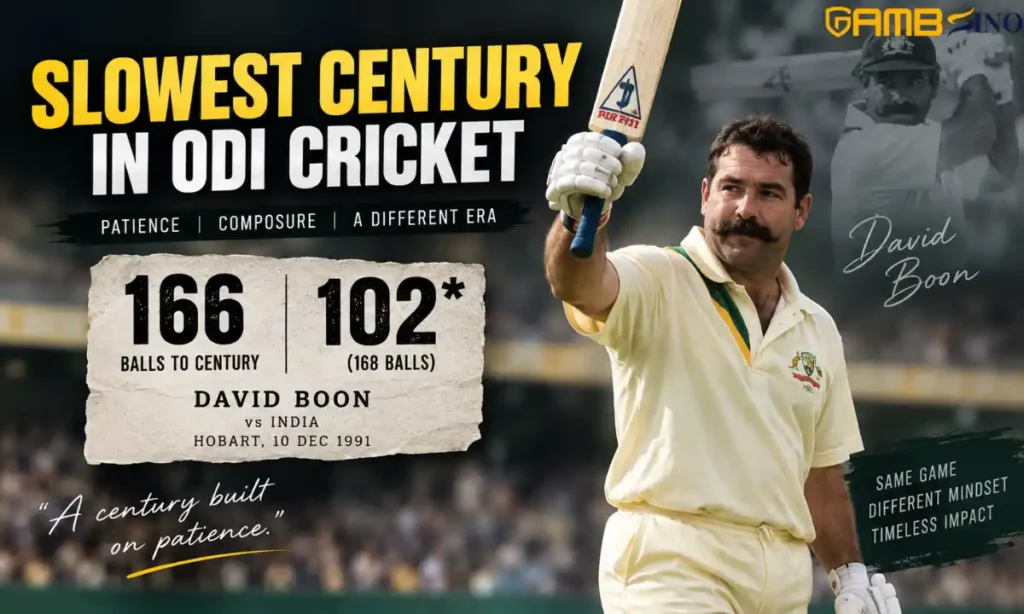
A century in One Day International cricket is one of the most celebrated achievements for any batter. In modern cricket, reaching 100 runs is often associated with aggressive stroke play, powerful hitting and a high scoring rate. However, ODI history has also witnessed centuries built on patience, concentration and careful accumulation rather than attacking cricket. The slowest ODI centuries tell a completely different story about how the game has evolved over the decades.
The record for the slowest century in ODI cricket belongs to former Australian opener David Boon, who took 166 balls to reach his hundred against India in 1991. He eventually remained unbeaten on 102 runs from 168 deliveries. His innings may look remarkably slow when compared with today’s standards, but it was highly effective in the context of the match. Australia successfully chased India’s target and won the game by eight wickets.
David Boon’s record is particularly interesting because it represents an era when ODI cricket was played with a much more conservative approach. Batters were expected to build innings patiently, protect their wickets and gradually take their team toward victory. The modern emphasis on strike rate and boundary-hitting was not nearly as strong at that time.
Who Scored the Slowest Century in ODI Cricket?
David Boon holds the record for the slowest century in men’s ODI cricket based on the number of balls required to reach 100 runs. He completed his century from 166 balls against India at Bellerive Oval in Hobart on December 10, 1991.
Boon finished the match unbeaten on 102 runs from 168 balls. His innings contained eight fours and no sixes, producing a strike rate of approximately 60.71. Australia needed only 176 runs to win after India scored 175/8, so Boon’s conservative approach was sufficient for the situation.
David Boon’s Slowest ODI Century
| Category | Details |
|---|---|
| Player | David Boon |
| Country | Australia |
| Opponent | India |
| Runs | 102* |
| Balls Faced | 168 |
| Balls to Century | 166 |
| Fours | 8 |
| Sixes | 0 |
| Strike Rate | 60.71 |
| Venue | Bellerive Oval, Hobart |
| Date | December 10, 1991 |
| Result | Australia won by 8 wickets |
The key figure is 166 balls. That is the number of deliveries Boon needed to move from zero to 100. He faced two additional balls after reaching his century and finished the innings on 102 not out.
David Boon’s Historic 166-Ball Century
The match between Australia and India was part of the 1991–92 triangular series involving Australia, India and the West Indies. India batted first and scored 175/8 from their 50 overs, setting Australia a target of 176.
Australia began the chase cautiously. Instead of immediately attacking India’s bowlers, the Australian batters concentrated on building a stable innings. Boon became the central figure in the chase and remained at the crease for almost the entire innings.
He faced 168 balls and scored 102 unbeaten runs. His eight boundaries were spread throughout the innings, while he did not hit a single six. Rather than taking unnecessary risks, Boon concentrated on finding singles, twos and occasional boundaries.
Australia eventually reached 176/2 in 48.3 overs. Boon’s unbeaten century therefore played a major role in securing the victory. Although the innings was extremely slow by today’s standards, it perfectly suited Australia’s requirements on that particular day.
Why Did David Boon Bat So Slowly?
Several factors explain why Boon’s century required so many deliveries. The first and most important factor was the match situation. Australia were chasing just 176 runs, which was not an enormous target. There was no need for the Australian batting order to take excessive risks.
Another major factor was the era in which the match was played. ODI cricket in the early 1990s was considerably different from the modern format. Powerplays, fielding restrictions and aggressive batting strategies had not developed to the level seen today.
Batters generally placed greater importance on preserving their wickets. A player who could remain at the crease for a long period and keep the scoreboard moving was considered extremely valuable.
Boon’s natural batting style also suited this approach. He was known for his determination, concentration and ability to occupy the crease. Instead of constantly searching for boundaries, he preferred controlled cricket and waited for scoring opportunities.
Slowest Century in ODI Cricket List
David Boon’s 166-ball century sits at the top of the slowest ODI century records. Several other famous batters have also produced exceptionally slow hundreds throughout ODI history.
| Rank | Player | Balls to Reach 100 |
|---|---|---|
| 1 | David Boon | 166 |
| 2 | Rameez Raja | 157 |
| 3 | Geoff Marsh | 156 |
| 4 | Rameez Raja | 152 |
| 5 | Scott Styris | 152 |
| 6 | Tom Cooper | 151 |
| 7 | Geoff Marsh | 150 |
| 8 | David Hemp | 150 |
These innings show how different ODI cricket was in earlier generations. Taking more than 150 balls to score a century is almost unimaginable in today’s game, especially when compared with the aggressive batting methods used by modern players.
Rameez Raja’s 157-Ball Century
Former Pakistan batter Rameez Raja occupies another prominent position among the slowest ODI centuries. He required 157 balls to reach three figures against the West Indies in Melbourne during the 1991–92 World Cup.
Rameez was known for his elegant batting and ability to build long innings. His century came at a time when ODI cricket was much more focused on building partnerships and preserving wickets.
His presence twice among the slowest ODI century records highlights how frequently patience played a central role in his batting. Unlike today’s players, batters of that era were often comfortable spending a large number of deliveries at the crease before accelerating.
Geoff Marsh’s 156-Ball Century
Australian opener Geoff Marsh also features prominently on the list. He took 156 balls to reach his century against England at Lord’s in 1989.
Marsh was one of Australia’s dependable opening batters during an important period in the country’s cricket history. His role was generally to provide stability at the top of the order and allow the middle order to take greater risks later.
His slow century is an excellent example of the traditional ODI opening role. Surviving the opening spell, building a partnership and reducing the risk of an early collapse were often more important than maintaining a high strike rate.
Marsh also recorded another extremely slow century against the West Indies, reaching his hundred from 150 balls. His appearances on the list demonstrate how valuable defensive technique and patience were during that period.
Scott Styris and His 152-Ball Century
New Zealand’s Scott Styris produced one of the slowest ODI centuries of the 2000s. He required 152 balls to reach his hundred against Sri Lanka during the 2007 World Cup.
Styris came into the match when New Zealand needed stability. Rather than playing a high-risk attacking innings, he concentrated on staying at the crease and accumulating runs.
His innings eventually produced an unbeaten century and helped New Zealand post a competitive total. Although his scoring rate was slow, the innings demonstrated the importance of staying at the crease when wickets are falling around a batter.
Styris’ century is particularly interesting because ODI cricket was already becoming more aggressive by 2007. Twenty20 cricket was beginning to influence batting techniques, but traditional innings-building remained important in difficult conditions.
Tom Cooper’s 151-Ball Century
Netherlands batter Tom Cooper is another player who appears among the slowest ODI century records. He took 151 balls to reach his hundred against Afghanistan in 2010.
By this period, ODI cricket had already changed significantly from the early 1990s. Batters were scoring faster, fielding standards had improved and limited-overs cricket had become more attack-oriented.
Cooper’s innings therefore demonstrates that slow centuries can still occur when a batter’s primary responsibility is to stabilise an innings. Match conditions, wickets and opposition bowling can all force players to adopt a conservative approach.
Is the Slowest Century the Same as the Lowest Strike Rate?
Not necessarily. This is an important distinction when discussing ODI records.
The slowest century is generally measured by the number of balls a batter needs to reach 100. A batter who takes 166 balls to score 100 has produced a slower century in terms of balls than someone who takes 140 balls.
Strike rate is calculated differently. It measures how many runs a batter scores per 100 balls faced.
David Boon reached his century from 166 balls and finished with 102 from 168 deliveries. His final strike rate was around 60.71.
Therefore, his innings was both exceptionally slow in terms of balls required for the century and conservative in terms of overall strike rate.
Slowest Century vs Slowest ODI Innings
A slow century should not be confused with the slowest innings in ODI cricket.
A player can score 100 runs very slowly and still produce a century. Another batter might score only 40 or 50 runs but take an extremely large number of balls. Such an innings could have a lower strike rate without qualifying for the slowest-century records.
The slowest-century record specifically focuses on the number of deliveries required to reach the three-figure milestone.
This is why David Boon’s 166-ball achievement remains significant even though there have been countless other low-scoring and slow-scoring ODI innings.
How ODI Cricket Has Changed
The biggest reason why Boon’s record has remained so unusual is the dramatic transformation of ODI cricket.
During the early years of ODI cricket, batting was generally more conservative. Teams were often satisfied with totals that would now be considered relatively modest. Batters were encouraged to build partnerships and avoid unnecessary risks.
Modern ODI cricket is completely different. The introduction and evolution of powerplays created greater opportunities for aggressive batting. Teams now actively target particular bowlers, exploit fielding restrictions and plan their innings around different phases.
The influence of T20 cricket has accelerated this transformation. Modern batters are trained to score quickly, use unconventional shots and maintain pressure on bowlers.
Fitness has also improved significantly. Players can run harder between the wickets and maintain intensity for longer periods.
As a result, a batter taking 166 balls to reach a century would consume more than half of the legal deliveries available in a standard 50-over innings. Such an approach would normally put enormous pressure on the rest of the batting lineup.
Why Is a 166-Ball Century So Difficult to Repeat?
In a 50-over ODI, a team has a maximum of 300 legal deliveries when batting for the full innings. If one player uses 166 balls to score 100, more than half of the available deliveries have already been consumed by one batter.
This can be particularly damaging when a team is batting first. The remaining players have fewer deliveries available to increase the total.
The situation is different during a small chase. If a team requires only 176 runs, as Australia did in Boon’s record innings, there is much less pressure to score rapidly.
This explains why match context is essential when judging slow centuries.
Boon’s Century Was Not a Failure
Looking only at the strike rate, it would be easy to label Boon’s innings as overly defensive. However, that would ignore the actual outcome of the match.
Australia won by eight wickets.
Boon remained unbeaten.
Australia successfully reached the target.
The innings therefore achieved its primary objective.
Cricket is ultimately a team sport. The value of an innings cannot always be measured by how quickly runs are scored. Sometimes the most valuable contribution is simply staying at the crease and preventing the team from collapsing.
Boon’s innings was a perfect example of that principle.
The Difference Between Boon and Modern Power Hitters
Modern ODI cricket has produced batters capable of reaching centuries in extraordinarily few deliveries. One of the most famous examples is AB de Villiers, who scored an ODI century from only 31 balls against West Indies in 2015.
The contrast with Boon’s 166-ball century is enormous.
| Record | Player | Balls |
|---|---|---|
| Fastest ODI Century | AB de Villiers | 31 |
| Slowest ODI Century | David Boon | 166 |
| Difference | — | 135 |
The two innings represent almost opposite approaches to limited-overs batting.
AB de Villiers attacked from the beginning and used extraordinary shot-making to reach his century at record speed. Boon relied on patience, defence, placement and gradual accumulation.
Both innings demonstrate exceptional skill, but their methods could hardly be more different.
What Can Modern Cricketers Learn from David Boon?
Boon’s innings provides several lessons that remain relevant even in modern cricket.
Patience Still Matters
Aggressive batting is valuable, but patience remains an important part of successful cricket. A batter must understand when attacking is appropriate and when survival should take priority.
Match Situation Comes First
A batter should not blindly follow a predetermined strike rate. The required run rate, wickets in hand, pitch conditions and opposition bowling all influence the correct approach.
Wicket Preservation Has Value
A batter who remains at the crease can continue scoring. Losing wickets while attempting unnecessary shots can create pressure for the entire team.
Building Partnerships Is Important
Boon’s innings demonstrates the value of spending a long time at the crease and allowing partnerships to develop.
Every Era Has Its Own Definition of Good Batting
A strike rate considered slow today could have been perfectly acceptable several decades ago. Cricket should therefore be judged within the context of its era.
Why the Record Remains Part of ODI History
Records associated with extreme performances tend to survive for generations because they represent unusual moments in cricket history. David Boon’s 166-ball century is one such achievement.
It is unlikely that modern ODI cricket will frequently produce situations where a batter can spend more than 160 balls reaching a century. Teams now place much greater importance on scoring efficiency.
That makes Boon’s record increasingly distinctive. As the game becomes faster, records from the slower era become historical reminders of how dramatically cricket has evolved.
Slowest ODI Century: Important Facts
- David Boon holds the record for the slowest ODI century by balls taken.
- He reached his century from 166 deliveries.
- The record was achieved against India in 1991.
- The match was played at Bellerive Oval in Hobart.
- Boon finished unbeaten on 102 runs.
- He faced 168 balls in total.
- He hit eight fours and no sixes.
- His strike rate was approximately 60.71.
- Australia chased India’s 175/8 successfully.
- Australia won the match by eight wickets.
- Rameez Raja is among the closest players to Boon’s record.
- Geoff Marsh also appears multiple times among the slowest ODI centuries.
Frequently Asked Questions
Who has scored the slowest century in ODI cricket?
David Boon of Australia holds the record for the slowest ODI century based on balls taken. He required 166 balls to reach 100 against India in 1991.
How many balls did David Boon take for his century?
David Boon took 166 balls to reach his century. He finished with 102 not out from 168 deliveries.
Against whom did David Boon score his slowest century?
Boon scored his record-breaking century against India at Bellerive Oval in Hobart.
When did David Boon score the slowest ODI century?
He scored the century on December 10, 1991.
What was David Boon’s final score?
David Boon finished unbeaten on 102 runs from 168 balls.
What was Boon’s strike rate?
His final strike rate was approximately 60.71.
How many fours did David Boon hit?
Boon hit eight fours during his unbeaten 102-run innings.
Did David Boon hit a six during the innings?
No. He did not hit any sixes in his record-setting century.
Who is second on the slowest ODI century list?
Rameez Raja is among the closest to Boon’s record, taking 157 balls to reach his century against the West Indies.
Can David Boon’s slowest-century record be broken?
Yes, it is technically possible, but modern ODI cricket makes such an innings extremely unlikely. Teams generally expect batters to maintain much higher scoring rates.
Conclusion
David Boon’s 166-ball century against India remains one of the most unusual batting records in ODI cricket. In an era when modern batters regularly score centuries from around 80 to 120 balls and occasionally much faster, Boon’s marathon hundred looks almost impossible by today’s standards.
Yet the innings should not be judged simply by its slow strike rate. Australia were chasing a modest target, Boon remained unbeaten and his team won the match comfortably. His approach reflected the cricketing philosophy of his era, where concentration, wicket preservation and partnership-building were highly valued.
The record also provides a fascinating comparison with the modern game. From Boon’s 166-ball hundred to AB de Villiers’ 31-ball century, ODI cricket has demonstrated an extraordinary range of batting styles. The difference between these performances illustrates just how much limited-overs cricket has evolved.
Ultimately, the slowest century in ODI cricket is more than an unusual statistical record. It is a snapshot of another era of the game a time when a batter could spend almost an entire afternoon constructing a century and still be considered the key player in a successful ODI victory.
Also, Read About: