
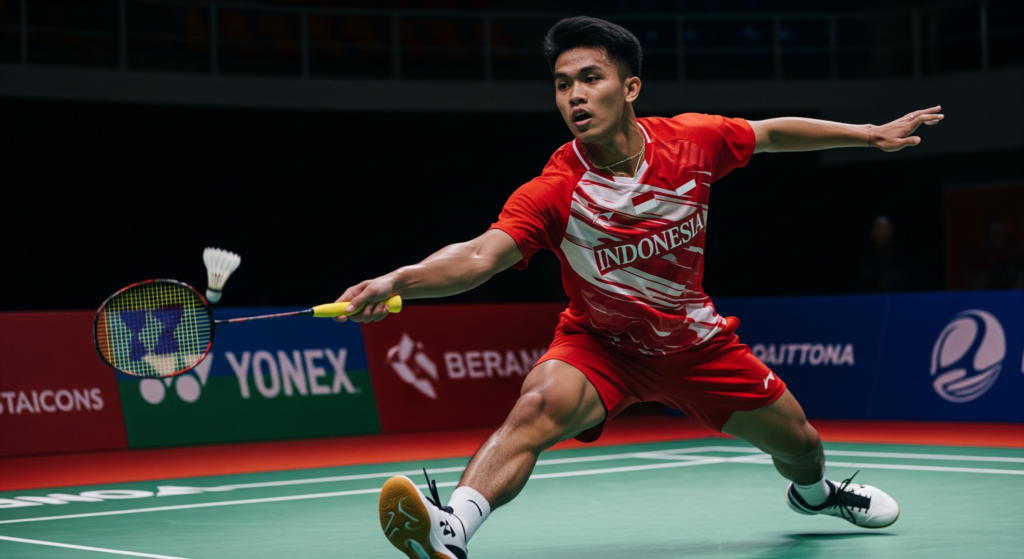
Indonesia’s badminton strength does not come from one academy, coach or generation. It comes from a layered system: local clubs identify children, major private programs sharpen them through age-group competition, and PBSI’s Pelatnas brings the best into a national training environment where selection continues after admission. The pathway is demanding and sometimes uneven, but unusually deep.
The results justify the pressure. Since badminton entered the Olympic program in 1992, Indonesia has won eight gold medals in the sport. As of July 2026, it also remains the Thomas Cup record holder with 14 men’s world team titles. Across sports in Indonesia, few disciplines carry the same public expectation. Within the Indonesia sports system, badminton also holds unusual institutional memory.
The Pipeline Starts With 4,933 Clubs, Not One Academy
PBSI’s athlete registry listed 93,318 players and 4,933 clubs in July 2026. Its four largest provincial totals were in DKI Jakarta, Central Java, West Java and East Java, each with more than 11,500 registered athletes. The database runs from U9 to adult level, showing how early formal competition begins inside the Indonesia badminton system.
That scale changes talent identification. A gifted child does not wait for a national scout to visit a school. Club tournaments and the national circuit test footwork, decision-making, recovery after defeat and adaptation.
Private Clubs Preserve the Technical Memory
Indonesia does not depend on a single state academy. PB Djarum, PB Jaya Raya, Mutiara Cardinal and Gideon Badminton Academy develop players before Pelatnas becomes realistic. At the 2026 national selection, PB Djarum won three of five sectors, while Jaya Raya and Gideon Badminton Academy produced one winner each.
PBSI’s talent-identification panel included Hendrawan, Bambang Supriyanto, Yoga Ukikasah and Hendra Aprida Gunawan. That link keeps coaching knowledge in circulation. Experienced coaches can see whether a junior reads the opponent’s racket face, protects the middle in doubles or loses technical shape under pressure.
Pelatnas Makes Selection an Ongoing Process
Winning a national trial is not an automatic lifetime pass into Cipayung. The 2026 Seleknas assessed results, technique, physical condition, mentality and development potential. Winners still had to clear physical, medical and psychological tests before receiving Pelatnas status.
PBSI also formalized a three-month internship route for regional athletes. Promotion can follow national titles, junior international results and coaching recommendations. Relegation decisions consider age, time in Pelatnas, results, KPI data, medical and physical development, psychology and attendance. Badminton Indonesia therefore operates a competitive national center rather than a closed senior squad.
Doubles Became the Country’s Technical Signature
Indonesia’s deepest continuity appears in doubles. Rexy Mainaky and Ricky Subagja won Olympic gold in 1996; Tony Gunawan and Candra Wijaya followed in 2000; Markis Kido and Hendra Setiawan did it in 2008. Tontowi Ahmad and Liliyana Natsir took mixed doubles gold in 2016, while Greysia Polii and Apriyani Rahayu delivered Indonesia’s first women’s doubles Olympic title at Tokyo 2020.
Those pairs were not tactically identical. They shared rigorous work on serve-return pressure, front-court interception, defensive rotation and positioning during flat exchanges. Indonesian badminton players learn doubles as a coordinated system, not two individual games on the same court.
Tournament Markets Reward Detail, Not National Emotion
The All England, Indonesia Open, World Championships and Olympic badminton can turn one deciding game into a national event. Pre-match prices reflect ranking points, recent workload, head-to-head history and any credible injury information, but live markets react to smaller details: a slowing first step, weaker lifts or a receiver beginning to dominate the service line. For readers tracking those shifts on 1xBet IOS, the real task is deciding whether three quick points indicate a tactical break or merely a short scoring run. A change of ends can alter drift, visibility and attacking rhythm, so chasing every movement in the odds can drain a bankroll faster than one incorrect prediction. Rally length, unforced-error patterns and movement between shots usually carry more weight than the noise inside Istora.
A full badminton schedule often leaves twenty or thirty minutes between featured matches, and digital audiences do not always remain on the same screen. Some move from the draw sheet and live score to dealer-led roulette, blackjack or baccarat, where sporting form no longer supplies useful information. A player opening live casino Indonesia during that break is entering a game shaped by fixed rules, betting limits and a built-in house edge rather than rankings or momentum. The camera angles and live dealer may resemble a sports broadcast, but each outcome still follows the table’s mathematical structure. Setting a session limit before play is more rational than trying to carry match-reading instincts from the badminton court to the casino floor.
Slots remove the human contest altogether. An RNG does not know that an Indonesian pair has just saved three match points, and the previous spin cannot influence the next one. Anyone browsing online casino Indonesia after the final rally should look first at the listed RTP, volatility profile, provider and bonus conditions rather than the size of the latest displayed win. RTP is a long-run theoretical percentage, not a promise for one session, while high volatility means payouts may be larger but arrive less frequently. A quiet sequence of spins is therefore not evidence that a win is “due”; it is simply variance operating inside the game’s programmed mathematics.
China, Japan and Denmark Build Champions Differently
China emphasizes centralized national-team depth. Japan’s S/J League is built around company-backed teams, while Denmark links its club base to talent centers and a national elite center. Indonesia sits between those models: private clubs build the base, domestic events filter the pool, and Pelatnas centralizes the final stage.
That hybrid system brings depth but not immunity from decline. Women’s singles has lacked the continuity seen in Indonesian doubles, while several pairings have struggled during generational change. Paris 2024 exposed the gap: Gregoria Mariska Tunjung earned women’s singles bronze, but Indonesia finished the badminton program without a gold medal.
Pressure Is Part of the Education
The Istora crowd is not a late-career surprise for Indonesian players. Juniors grow up where badminton results lead sports coverage, club reputations matter and national-team selection is discussed far beyond the training hall. That attention can sharpen competitive nerve, though it can also make an ordinary loss feel national.
PBSI’s current framework aims to make selection less dependent on reputation. Performance data, physical and medical testing, psychology, attendance and formal promotion or relegation criteria now sit beside medals. The next world-class player may still emerge from a crowded local hall, but the route from that hall to Pelatnas is increasingly documented point by point.